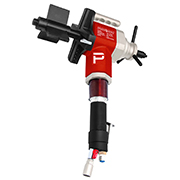
Go to any pipe yard at 8 in the morning and you’ll hear the grinders before you see anyone. A couple of fitters bent over pipe ends, sparks flying, checking the angle by eye. Then grinding a bit more. Then checking again.
It’s slow, it’s messy and the edges rarely come out the same twice. Pipe bevellers sort out most of that, and they’re not as complicated as people think.
What is a pipe beveller?
When you weld two thick pipes together, you can’t just butt the flat ends up against each other. The weld won’t go deep enough. So the ends are cut at a slant, usually somewhere around 37 degrees. Put two of those ends together and you get a small V-shaped gap for the welder to fill.
A pipe beveller is the machine that cuts that slant. You clamp it onto the pipe, set the angle and let it run round the end. A few minutes later, you’ve got a clean, even edge. Do the next pipe and it comes out exactly the same.
Is a grinder good enough?
For one or two pipes, maybe. Lots of small jobs still get done that way.
The trouble starts when you’ve got 50 joints to prep. Honestly, even a very good fitter can’t hold the same angle by hand all day. One end ends up a bit steep, another a bit flat. The welder then has to fill bigger gaps, which uses more rod and more time. And if the joint fails an X-ray test, someone has to cut it out and start again.
Grinders also throw a lot of sparks. In a refinery or a gas plant, that’s a big worry.
Different types of pipe bevelling machines
You’ll see a few kinds of pipe bevelling machines out there.
Some are small and portable. They lock inside the end of the pipe, and one person can carry them around the site. Crews like these for repair work.
Others are split frame machines, sometimes called clamshells. They open up, close around the outside of the pipe and then cut. These are useful when the pipe is already fixed in place and you can’t get to its open end. A lot of them cut the pipe and bevel it in one go.
Most of these machines cut cold, without a flame. So the metal doesn’t get heat damage, and the fire risk is much lower.
What to check before you buy
Look at the pipe sizes you deal with most. The machine needs to fit them. Check the wall thickness as well, since thick pipe needs a stronger machine. If your work is mostly out in the field, a lighter portable model will save your crew a lot of carrying. And ask the supplier if they’ll show your team how to use it and fix it when something wears out.
Conclusion
If your team still preps every pipe with a grinder, pipe bevellers are worth a look. They give you the same clean edge on every joint and cut down on rework.
POWERMASTER makes pipe bevelling machines, including split frame clamshell models that cut and bevel cold. It also handles installation, training, calibration, repairs and maintenance, so you’re not left on your own after the sale.