A contractor in Mohali learned this the expensive way. On one project, he bought the cheapest country bricks he could find. The walls came out uneven. Joints were thick in some places and thin in others. His team used far more cement mortar than planned, and the plaster had to be laid extra thick just to hide the waves.
On his next project, he switched to machine made bricks. The brick itself cost more. The building cost less.
That's the part most people miss when they compare bricks only by price per piece.
What are machine made bricks?
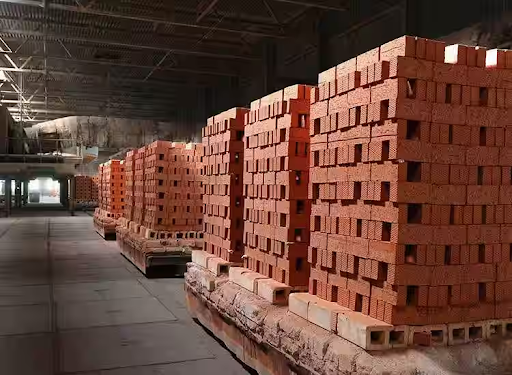
Machine made bricks are clay bricks shaped by machines instead of by hand. Prepared clay is pressed or extruded through a machine, cut to size, dried under control and fired in a kiln. This gives bricks that are uniform in size, smooth in finish and consistent in strength from one piece to the next.
You'll often see them sold as wirecut bricks, because many are cut from an extruded clay column using a wire.
And how are handmade bricks made?
Traditional handmade bricks are still the most common bricks in India. Workers mix clay with water, press it into wooden or metal moulds by hand, and leave the green bricks to dry in the sun. They are then fired in large kilns, often the tall-chimney kilns you see along highways.
It's a centuries-old method, and it works. But because so much depends on hand work and open-air drying, the results vary quite a lot.
Worth knowing, though: handmade doesn't always mean low quality. Some premium hand moulded facing bricks are made carefully, on purpose, for their rustic texture and character. That's a different product from the rough country brick used behind plaster.
The key differences
Size is the first big one. Machine made bricks come out almost identical, so walls rise straight and joints stay thin and even. Handmade bricks can differ by several millimetres, which masons then correct with extra mortar.
Finish comes next. Machine made bricks have clean faces and sharp corners, so they can be left exposed. Most common handmade bricks need plaster to look neat.
Strength and water absorption also tend to be more predictable in machine made bricks, since clay preparation, drying and firing are better controlled. Handmade bricks from a good kiln can be strong too, but quality can change from batch to batch.
Then there's wastage. Fewer broken and misshapen bricks means less money thrown away on site.
Where machine made bricks save you money
The saving usually doesn't show up on the brick bill. It shows up everywhere else.
Straighter walls need less mortar. Plaster can be thinner, or skipped completely on exposed faces. Masons work faster because they aren't fighting uneven bricks. Breakage is lower. And if you choose perforated machine made bricks, the lighter weight can reduce the load on your structure too.
Add all of that up, and the higher price per brick often evens out, or turns into a real saving.
Are there any downsides?
A few. The upfront cost per brick is higher. In some remote areas, machine made bricks may not be stocked locally, so transport adds to the cost. And for walls that will be fully plastered and painted, some builders feel the extra finish isn't needed.
That's a fair point. It really depends on the project.
How to choose machine made bricks manufacturers and suppliers
Start with experience. A manufacturer that has been firing clay for decades understands how local clay behaves in different seasons.
Ask for test reports on compressive strength and water absorption. Visit the factory if you can. Check a random sample from the stock, not just the polished display piece. Ask about delivery timelines, how bricks are stacked on the truck, and what happens if a load arrives with too many broken pieces.
Good machine made bricks manufacturers and suppliers will answer these questions clearly and without getting defensive.
Mahaluxmi Bricks is one example of a manufacturer with that kind of experience. The company has been making clay products in Panchkula, Haryana, since 1982 and holds ISO 9001 certification. Builders, architects and home owners looking for trusted machine made bricks manufacturers can view their wirecut, hand moulded and special shape bricks online.
So, which should you pick?
If your walls will be exposed, or you want straight, fast, clean construction with less waste, machine made bricks are usually the smarter choice. If you're building a simple boundary wall that will be plastered and painted, good handmade bricks can still do the job.
Just don't compare them on the price of one brick alone. Compare the cost of the finished wall.