A science block gets sanctioned. Twenty microscopes are ordered, delivered, unpacked and put on benches, and for one term everything is fine.
By the second year, four of them are in the store cupboard. Not broken exactly — one has a stiff focus, one has a chipped objective, two have illumination units that stopped working and cannot be replaced because nobody knows what to order or from whom.
This is the most common outcome of a bulk microscope purchase in India, and almost all of it is preventable at the quotation stage.
Consistency across units matters more than anyone expects
In a teaching lab, students compare results across benches. If four instruments in a batch of twenty behave differently, the practical stops being a lesson in observation and becomes an argument about equipment.
Units from a single production run behave the same way. Units assembled from mixed stock, or sourced from more than one origin, do not — and a trader filling a large order often does exactly that without mentioning it.
Ask whether the full quantity comes from one production batch. Manufacturers can answer this directly. SUSWOX, which has built student microscopes in Ambala since 1973, supplies school and college batches from a single run for precisely this reason.
Buy for how the instrument will be handled
A school microscope is not handled like a laboratory microscope. It is carried across corridors, focused by beginners with real force, and stored in a cupboard through a long summer.
So metal bodies over plastic, simple mechanics over delicate ones, and a focus mechanism that does not develop play after a year. These are not premium features. They are the difference between twenty working instruments and sixteen.
Match the model to the class level
For senior school biology, a monocular compound microscope with 10x, 40x and 100x objectives and LED illumination covers the syllabus comfortably and keeps a twenty-unit order affordable.
For degree-level practicals, binocular heads are worth the difference. Two-eye viewing is much less tiring across a two-hour session, and by that stage students stay on one slide long enough for the fatigue to matter. Add oil immersion if microbiology is on the syllabus.
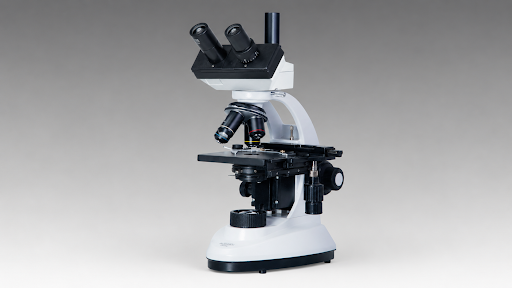
And if the department also demonstrates to a full class, one trinocular or projection instrument saves the lecturer from repeating the same explanation thirty times at an eyepiece.
The paperwork that decides government orders
For state and government institutions, the technical evaluation stage rejects more submissions than price ever does.
ISI certification against the exact model quoted, proforma invoices, technical compliance sheets, OEM certificates, authorisation letters, GeM listing — every one of these has to be correct and current. The microscope suppliers in India that actually manufacture issue these documents themselves, which is faster and cleaner than a trader requesting them from someone else while a deadline runs down.
Plan delivery, and plan for the year after
Large orders rarely need to arrive at once. A phased installation across a construction schedule or an academic calendar is usually easier to manage, and most manufacturers will stagger dispatch if it is agreed in writing before the order is booked.
Then there is the part nobody asks about at purchase time. Objectives get damaged. Slide clips go missing. Illumination units fail. All of that is normal, and all of it needs parts.
So ask, before approving the quotation, how long spares stay available for the exact model. A school buys microscopes once in a decade. The answer to that single question decides whether the purchase serves the whole decade or only part of it.
Do not order the entire budget in one specification
A lab that buys twenty identical instruments has twenty identical limitations.
Most departments are better served by a mixed order — the bulk of the batch in the standard teaching model, plus one or two better-specified units for demonstration, project work and photography. The cost difference across a full order is small. The difference in what the department can actually do with the lab is not.
Tell the supplier the syllabus and the class sizes and ask for the split to be quoted both ways before you decide.
Train the people who will use them
This costs nothing and prevents most of the damage.
A large share of school microscope failures come from the same three mistakes — driving the objective into the slide while focusing from the wrong direction, cleaning lenses with whatever cloth is nearby, and storing instruments without covers in a damp cupboard. Fungus on optics in a monsoon climate is a real problem and an entirely avoidable one.
Ask the supplier for a short handling and maintenance session at installation, and ask for it in writing in the order. Twenty minutes with the lab staff at the start protects the whole batch for years.
A short checklist
Confirm the units come from one production run. Confirm the ISI certificate covers the model quoted. Confirm spares availability in years, with an example. Confirm who handles service and how long they take.
Four questions, asked before the order rather than after. They take one phone call and they are the difference between a lab that still works in 2036 and a cupboard full of instruments nobody can