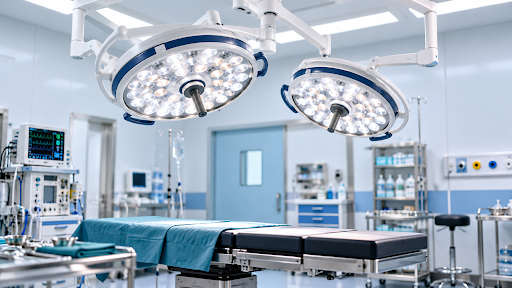
Two minutes. That is how long the anaesthetist waited while the table motor whined and refused to go into Trendelenburg. The patient was already under. The table was four years old, bought at a good price, from a supplier nobody could reach anymore.
It got fixed. It also got replaced six weeks later.
Operating tables are strange purchases. They sit in the middle of every surgery, they carry the patient, and yet they get far less scrutiny during procurement than the lights above them or the monitors beside them. Most hospitals compare two numbers — price and load capacity — and stop there.
That is not enough. Here is what a purchase committee should actually put to an OT table manufacturer before signing anything.
Load capacity and safe working load are different things
A table rated for 250 kg static load will not necessarily hold 250 kg while tilting 30 degrees laterally with the back section raised.
Ask for the safe working load in articulated positions, not just flat. This one distinction explains most of the motor failures you hear about in the third year. A manufacturer who does not publish that figure either has not tested it or does not want to.
Positioning decides which surgeries you can take on
This is the part that quietly limits a hospital.
If the table cannot drop low enough for a spine case or rise high enough for a tall surgeon, your OT list gets shorter. Check the height range at both ends. Check Trendelenburg and reverse Trendelenburg degrees. Check lateral tilt. Check kidney bridge travel, back section range, and whether the leg sections split and drop independently.
And then check how fast it all moves. A table that takes forty seconds to reposition is a table that irritates everyone in the room.
C-arm compatibility is not a checkbox
Almost every table today is advertised as "radiolucent". That word does very little on its own.
What you need to know is the actual free imaging length in centimetres, where the column sits, and whether the base allows the C-arm to come in from both sides. Carbon fibre tops give cleaner images than radiolucent laminate. If you do ortho trauma, urology or vascular work, ask for the imaging window drawing — not a sentence in a PDF.
Hydraulic, electro-hydraulic, or fully electric?
Honestly, there is no universal right answer here.
Manual hydraulic tables are cheaper, simpler and almost impossible to kill. They are also slower and harder on the OT assistant. Electro-hydraulic tables give you battery backup, remote control and smooth movement, but you are now dependent on a control board and a battery pack that will need replacing in five or six years.
Decide based on your case load and your power situation, not on which one looks more modern.
Certification and who you are really buying from
CDSCO registration is mandatory in India. ISO 13485 shows the factory runs a medical-device quality system. CE marking and USFDA registration matter if your hospital is chasing accreditation or you simply want a higher build standard.
Also worth knowing: many companies selling operating tables in India do not make them. They import, rebadge, and disappear when a part fails. Ask for the manufacturing address. A genuine OT table manufacturer will happily invite you to the plant.
Service is the whole game
Ask three questions and listen carefully to the answers.
How long does a spare part take to reach your city? Is there a trained engineer within a day of travel? And how long is the company keeping spares for your specific model after it goes out of production? Seven years is reasonable. Two is not.
Companies with a large distributor network across India — some run well over a thousand channel partners — answer this far more confidently than single-office importers.
Why export experience is worth checking
A company that works as an OT table exporter to markets across the Gulf, Africa and Southeast Asia has to pass different inspections in every country. Those checks do not apply to one export batch. They apply to the production line.
So the table built for a hospital in Ambala comes off the same line, with the same welds and the same testing, as the one going to Nairobi. Export volume is not a vanity number. It is evidence.
Before the purchase order goes out
Sit on the table. Seriously. Operate the controls yourself, watch how the mattress sections separate, check whether the pads are seamless and easy to clean, look at how the side rails accept accessories you already own.
Ask for the accessory list too. Arm boards, shoulder supports, leg holders, anaesthesia screens — these are sometimes priced separately and can quietly add a lot to the bill.
An operating table lasts twelve to fifteen years if it is built well. Choose the manufacturer with that timeline in mind, not this quarter budget.
The hospital with the stuck table learned that. The second table came from a real factory, with a real engineer two hours away, and it is still running.