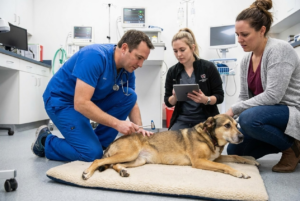
Discovering your dog is suddenly paralyzed terrifies pet owners, demanding immediate veterinary attention. Sudden paralysis in dogs represents a neurological emergency requiring rapid diagnosis and intervention. Multiple conditions cause acute paralysis—some reversible with urgent treatment, others causing permanent disability without quick intervention. This guide explains common causes, emergency protocols, diagnostic approaches, and treatment options.
Common Causes of Sudden Paralysis
Intervertebral Disc Disease (IVDD)
Mechanism: Disc herniation causes spinal cord compression.
Presentation: Sudden hind limb weakness or paralysis, often following minor trauma or activity.
Breed predisposition: Dachshunds, Corgis, Basset Hounds, Poodles particularly susceptible.
Timeline: Symptoms develop within minutes to hours.
Urgency: Emergency surgery within 24-48 hours dramatically improves recovery (80-90% success early vs. 50% if delayed).
Fibrocartilaginous Embolism (FCE)
Mechanism: Disc material enters spinal blood vessel, blocking blood flow causing spinal cord infarction.
Presentation: Sudden, severe spinal cord damage (often worse than IVDD).
Progression: Develops over minutes to hours; non-progressive after initial event.
Prognosis: Guarded; variable depending on infarction severity.
Timeline: Peaks 4-6 years old; no treatment proven effective.
Spinal Trauma
Causes: Hit by car, falls, forceful jumping causing fracture/luxation/contusion.
Presentation: Sudden paralysis following known trauma.
Emergency need: Surgery within 24 hours prevents secondary spinal cord damage.
Success: Depends on injury severity, neurological status at presentation.
Bloat (Gastric Dilatation-Volvulus)
Mechanism: Stomach distension and rotation causes systemic shock, sometimes spinal cord involvement.
Presentation: Acute abdominal distension, retching, sometimes hind limb weakness.
Urgency: Life-threatening emergency requiring immediate surgery.
Incidence: Large breed dogs, particularly Great Danes, German Shepherds.
Toxins
Specific toxins causing paralysis:
- Tick paralysis: Tick toxin blocks neuromuscular transmission
- Snake venom: Neurotoxins affect neuromuscular junction
- Heavy metals: Mercury, lead cause peripheral neuropathy
- Medications: Some antibiotics, chemotherapy agents
Progression: Variable by toxin; some reversible if toxin removed quickly.
Myasthenia Gravis Crisis
Mechanism: Autoimmune disease attacks neuromuscular junction.
Presentation: Generalized weakness, megaesophagus, sometimes acute decompensation.
Myasthenic crisis: Sudden severe weakness requiring respiratory support (rare but devastating).
Treatment: Immunosuppressive therapy once diagnosed.
Guillain-Barré-Like Syndrome
Mechanism: Immune-mediated inflammation of peripheral nerves.
Presentation: Ascending paralysis (hind limbs first, progressing forward).
Progression: Over days to weeks.
Prognosis: Variable; some dogs recover completely, others develop permanent disability.
Emergency Response Protocol
Immediate Actions (First 30 Minutes)
- Assess breathing: If respiratory muscles affected, emergency oxygen/ventilation needed
- Check for obvious trauma: Assess for hit-by-car injuries (internal bleeding)
- Test bladder/bowel: Paralysis typically involves loss of control
- Keep dog calm: Stress exacerbates condition
- Do NOT delay transport: Call emergency clinic immediately
Transportation Safety
- Minimize spinal movement: Gentle handling prevents additional spinal cord trauma
- Support paralyzed limbs: Prevent self-injury during movement
- Direct transport: Go straight to emergency clinic (no stops)
- Alert clinic ahead: Enables staff preparation for neurological emergency
Initial Emergency Evaluation
Emergency veterinarians assess:
- Breathing adequacy (respiratory muscle assessment)
- Conscious/alert status
- Pain sensation (deep pain preservation critical prognostically)
- Bladder function
- Blood pressure/perfusion status
This rapid assessment guides urgency and diagnostic testing.
Diagnostic Approach
Spinal Cord Assessment
Imaging priority: MRI gold standard (localizes lesion, determines compressibility)
Timeline: Obtained within hours of presentation if emergency surgery contemplated
Alternative: CT provides bone detail if trauma suspected, MRI unavailable
Differential Diagnosis Considerations
- IVDD vs. FCE: Similar presentation, different treatments (surgery vs. supportive)
- Trauma vs. non-traumatic: History guides imaging focus
- Central vs. peripheral: Neurological exam patterns help differentiate
Proper diagnosis determines treatment approach.
Treatment Options
Surgical Decompression (IVDD)
Indication: Herniated disc compressing spinal cord.
Urgency: Within 24-48 hours optimal.
Success: 80-90% early ambulation recovery vs. 50% if delayed.
Procedure: Laminectomy or hemilaminectomy removes disc material.
Conservative Management (Appropriate Cases)
Indication: Partial paralysis, disc material not surgically compressible, financial/health constraints.
Components:
- Strict cage rest (6-8 weeks)
- Pain management (critical)
- Anti-inflammatory medications
- Physical rehabilitation
- Monitoring for progression
Recovery slower but possible in selected cases.
Supportive Care (Non-Surgical Cases)
- Pain management: Aggressive analgesia
- Bladder/bowel management: Catheterization, manual expression, medications
- Physical therapy: Passive range of motion, rehabilitation exercises
- Nursing care: Pressure ulcer prevention, hygiene maintenance
Meticulous supportive care crucial for non-surgical cases.
Prognosis Factors
Favorable prognostic signs:
- Deep pain preservation (predictor of ambulation recovery)
- Early intervention (within 24-48 hours)
- Younger age, general health
- Appropriate surgery timing
Unfavorable signs:
- Absent deep pain (very poor prognosis)
- Delayed treatment (>72 hours post-onset)
- Advanced age, comorbidities
- Unable to perform surgery
Long-Term Management
Recovery timeline: 8-12 weeks is typical for significant improvement.
Ongoing physical therapy: Weeks to months post-op maximize recovery.
Recurrence prevention: Avoid high-impact activities, maintain a healthy weight, gradual activity.
Quality of life: Many paralyzed dogs enjoy excellent life with proper management and assistive devices.
Conclusion
Sudden paralysis in dogs demands rapid veterinary evaluation and intervention. Understanding common causes, emergency response protocols, and treatment options empowers pet owners to make quick decisions, potentially determining outcome differences between recovery and permanent disability. When paralysis develops acutely, every hour matters—immediate professional assessment proves crucial.
Read more : https://friendsoftoms.org/category/business/service/