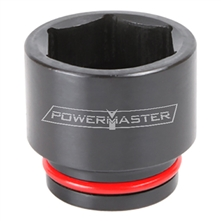
Most toolboxes in industrial settings carry both socket types, often stored right next to each other. The visual similarity leads workers to assume the two serve identical purposes. That assumption results in cracked tools, stripped fasteners, and unplanned downtime. Personnel who operate around power tools must recognize that impact sockets constitute a separate category, not merely a minor variation of the standard socket.
The Limitations of Using Standard Sockets with Power Tools
Regular sockets are designed for hand tools. Chrome vanadium steel performs adequately when torque is applied slowly with a ratchet or breaker bar. The steel possesses sufficient strength under that controlled, steady load.
Pneumatic and hydraulic impact wrenches operate on an entirely different principle. They generate short, aggressive rotational bursts instead of continuous pressure. Chrome vanadium steel cannot withstand that repeated shock loading. The material turns brittle under those conditions, and failure occurs without prior visible warning.
Distinguishing Features of Impact Sockets
The process begins with the material. High-strength alloy steel undergoes a heat treatment process that creates a precise balance between hardness and flexibility. Excessive hardness makes the socket brittle. Insufficient hardness allows deformation. The heat treatment reaches the midpoint that permits repeated shock absorption without loss of shape or cracking.
Beyond the material, construction details provide further differentiation:
- Optimized wall thickness supplies structural strength while maintaining sufficient narrowness to fit around fastener heads in confined spaces.
- Chamfered openings at both ends accelerate engagement between the drive tool and the fastener, reducing fumbling during active work.
- Concentric openings with large clearance holes meet the dimensional standards required by industrial applications.
- Black oxide finish over plating protects against corrosion in humid, outdoor, and chemically exposed environments.
- Ring-and-pin retention secures the socket to the drive during operation, so it does not separate under high torque.
The black matte finish delivers an additional practical benefit beyond rust protection. It distinguishes the socket from chrome hand tools at a glance, which enables workers to select the correct item rapidly without hesitation under time pressure.
Understanding the Freecorner Profile
Standard socket profiles make contact with fastener heads at the corners. Repeated high-torque application concentrates stress at those corner points. This action rounds the fastener over time and increases removal difficulty.
The Freecorner profile moves the contact away from the corners and distributes the load across the fastener's flat faces. This approach reduces rounding on new fasteners, improves success rates for worn bolts, and reduces internal stress in the socket. For applications that involve restricted access or costly fastener replacement, the design produces measurable effects on productivity and cost.
Choosing Reliable Suppliers
Heavy equipment maintenance, structural steel assembly, turbine servicing, and oil and gas operations share one common requirement: tools that perform consistently under sustained stress. Socket quality varies widely across the market, and visual appearance alone fails to indicate performance levels.
Engagement with trusted impact socket suppliers who manufacture to industrial specifications eliminates that uncertainty. Verified material composition, proper heat treatment, and accurate dimensional tolerances determine whether a socket endures or fails during operation.The distinction between impact sockets and regular sockets rests on engineering principles, not branding. Selecting the correct type from the appropriate source is part of proper job execution.