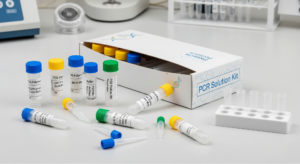
A single bad PCR run can wreck an entire day in the lab. Samples get wasted, reports are delayed, and confidence in your data takes a hit. Many US labs run into this problem because they choose vendors too quickly. The one-line fix is straightforward: evaluate PCR solution kit providers based on real performance, regulatory fit, and day-to-day reliability before committing.
Below is a practical, no-nonsense framework that labs across the US can use to make smarter decisions and avoid preventable headaches.
Start With A Clear Picture Of Your Lab Workflow
Before you even look at vendors, you need to understand how PCR actually functions inside your lab.
A kit that works great for low-volume academic research may fall apart under the pressure of a busy clinical workflow. On the flip side, a kit built for high-throughput diagnostics might be overkill for routine screening.
Ask these questions internally:
- How many PCR runs do you perform each week
- Are you running standard PCR, RT PCR, or qPCR
- Do you handle clinical, research, or mixed-use samples
- What sample types are most common
Clear answers help narrow your options fast and prevent mismatches later.
Verify Regulatory And Quality Standards In The US
In the US, compliance is not a bonus feature. It is the baseline.
Every kit should come with transparent documentation that matches how your lab operates. If you are CLIA-regulated or working with clinical samples, this step matters even more.
Look for:
- FDA classification, such as RUO or IVD
- Manufacturing aligned with ISO 13485
- Clear labeling and traceability
- Accessible quality control documentation
If a provider struggles to explain compliance in plain language, that is a warning sign.
Dig Into Performance Data Instead Of Marketing Claims
Most PCR kits promise sensitivity and accuracy. That does not mean much without proof.
Request performance data that reflects real conditions, not ideal lab setups.
Useful data includes:
- Limit of detection studies
- Sensitivity and specificity results
- Cross-reactivity testing
- Validation across common thermocyclers used in the US
Strong PCR solution kit providers expect these questions and usually share data without hesitation.
Check Reproducibility and Lot-to-Lot Consistency
One clean run does not guarantee long-term reliability.
Lot-to-lot variation can quietly sabotage results over time, especially in regulated labs.
Ask about:
- Batch release criteria
- Internal consistency testing
- Stability data under typical US shipping conditions
- Reported variability across lots
Consistency is what keeps your data trustworthy month after month.
Evaluate Ease Of Use And Error Risk
A kit that looks good on paper can still cause issues at the bench.
Complex workflows increase the chance of pipetting errors and technician fatigue. This becomes a big deal in high-volume labs.
Pay attention to:
- Number of preparation steps
- Reaction setup time
- Compatibility with existing lab equipment
- Clarity of instructions
Simple protocols often outperform complex ones in real-world conditions.
Review Technical Support And Documentation Quality
Even experienced labs run into problems. What matters is how fast those problems get solved.
Strong support is a sign that a provider understands real lab pressures.
Evaluate:
- Availability of US-based technical support
- Response times during business hours
- Depth of troubleshooting guides
- Quality of protocol documentation
Good support can save hours when results do not look right.
Compare Total Cost, Not Just Price Per Kit
The cheapest kit is rarely the most affordable option long term.
A smart cost comparison includes everything that affects your workflow and output.
Consider:
- Cost per reaction
- Frequency of failed runs
- Repeat testing expenses
- Shipping speed and storage needs
Many labs learn the hard way that cutting corners upfront costs more later.
Run Internal Validation Before Committing
Never rely solely on vendor data.
Internal validation using your own samples and staff reveals issues that spec sheets cannot.
Your validation should track:
- Run-to-run consistency
- Signal clarity and background noise
- Technician feedback
- Overall turnaround time
This step is where good vendors separate themselves from average ones.
Think Long-Term Partnership, Not One-Time Purchase
PCR kits are not a one-off decision. They affect daily operations.
Consider whether the provider:
- Updates protocols as technology evolves
- Communicates changes clearly
- Maintains consistent availability
- Supports scale as your lab grows
Reliability over time matters more than flashy features.
Conclusion
Choosing between PCR solution kit providers is ultimately about protecting your results, your workflow, and your reputation. When US labs take the time to assess compliance, performance, consistency, and real-world usability, they avoid the trial-and-error cycle that wastes time and money. A careful evaluation today leads to smoother runs, cleaner data, and fewer surprises tomorrow.
Read More : https://friendsoftoms.org/category/health-fitness/