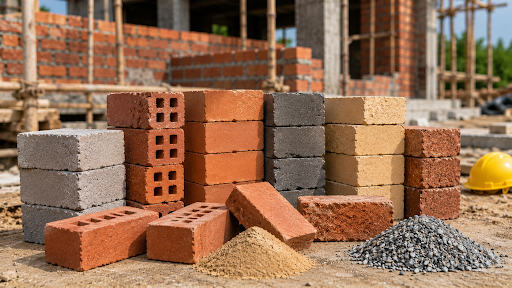
An exposed brick façade is the only elevation finish that has no undo button.
Paint you can redo. Cladding you can replace. But once a wall is built in exposed brick with pointed joints, changing your mind means demolition.
Which is exactly why the decisions made in the first week matter so much more than usual.
The brick has to be chosen for the face, not just the wall
In a plastered wall, the brick disappears. Nobody sees the chipped corner or the slightly warped edge, because eighteen millimetres of plaster hides all of it.
Exposed work removes that safety net.
Now the edge has to be square. The face has to be flat. The colour has to hold across thousands of units. A single soft, pale brick in the middle of a red façade will catch your eye every time you park the car, forever.
This is why exposed elevations almost always use wirecut machine made units. The extrusion and wire cutting process delivers the sharp arris and repeatable dimensions the finish depends on. Most serious machine made bricks manufacturers and suppliers keep a dedicated exposed or face brick range for exactly this reason — it is a different product from a common structural brick, even if it looks similar in a photo.
Order the whole thing in one batch
This is the mistake that ruins otherwise good façades.
Clay deposits shift slightly. Firing cycles vary between production runs. Two batches made three months apart can be perfectly good bricks and still sit half a shade apart on the same wall.
You will not notice it on the pallet. You will notice it on the elevation, in afternoon light, from across the street.
So calculate the full façade quantity, add ten percent for cuts and breakage, and buy it all at once from one batch. Store it properly, covered and off the ground.
Joints do half the work
People obsess over brick colour and barely think about mortar. Then they are surprised when the finished wall looks nothing like the reference image.
Joint colour and profile change the entire character of a façade.
- A recessed joint throws a shadow line and makes each brick read separately — crisp, contemporary
- A flush joint flattens the wall into one surface — quieter, more monolithic
- Dark mortar with red brick sharpens the grid pattern significantly
- Light or matching mortar softens it, and makes the wall read as a single mass
- Joint width matters as much as colour — thin joints look precise, wide ones look rustic
Build a sample panel. One square metre, using the actual bricks, actual mortar mix, actual joint profile. Look at it in morning light and again at four in the afternoon. Then decide.
Sample panels feel like a waste of two days. They are the cheapest insurance on the entire project.
Plan for water, because water is the real enemy
Exposed brick has no plaster protecting it, which means the joints are your waterproofing.
Pointing must be complete and properly compacted. Any gap becomes an entry point, and water inside a wall shows up later as efflorescence — that white salt bloom that appears on the face and is genuinely difficult to remove once it starts.
Copings on parapets, drip grooves at projections, proper sill details under windows. These are not decorative additions. They are what keep water running off the face instead of into it.
Choose a low-absorption brick as well. A dense unit from a controlled brick manufacturing factory simply takes in less water than a soft one, and that difference compounds over twenty monsoons.
Get a mason who has done it before
Exposed brickwork is a different skill from ordinary masonry. Coursing must stay perfectly level, verticals must be true, and the joints must be uniform in width because every deviation is permanently visible.
A good general mason is not automatically a good face-brick mason. Ask to see previous exposed work before hiring.
Where to buy
Look for a supplier with a face brick range, batch consistency, and a track record long enough to still be around when you need a top-up.
A brick making company that has been producing continuously for decades gives you something a trading house cannot — the same clay, the same kiln, the same product line next year. Mahaluxmi Bricks has run from Panchkula since 1982 with wirecut, jali, special shapes, and matched roof tiles in its catalogue, which is the kind of range an elevation actually needs.
Before you commit
Build the sample panel. Buy one batch. Sort out water detailing at drawing stage.
Do those three things and exposed brick ages beautifully. Skip them and it ages fast, in the wrong direction.